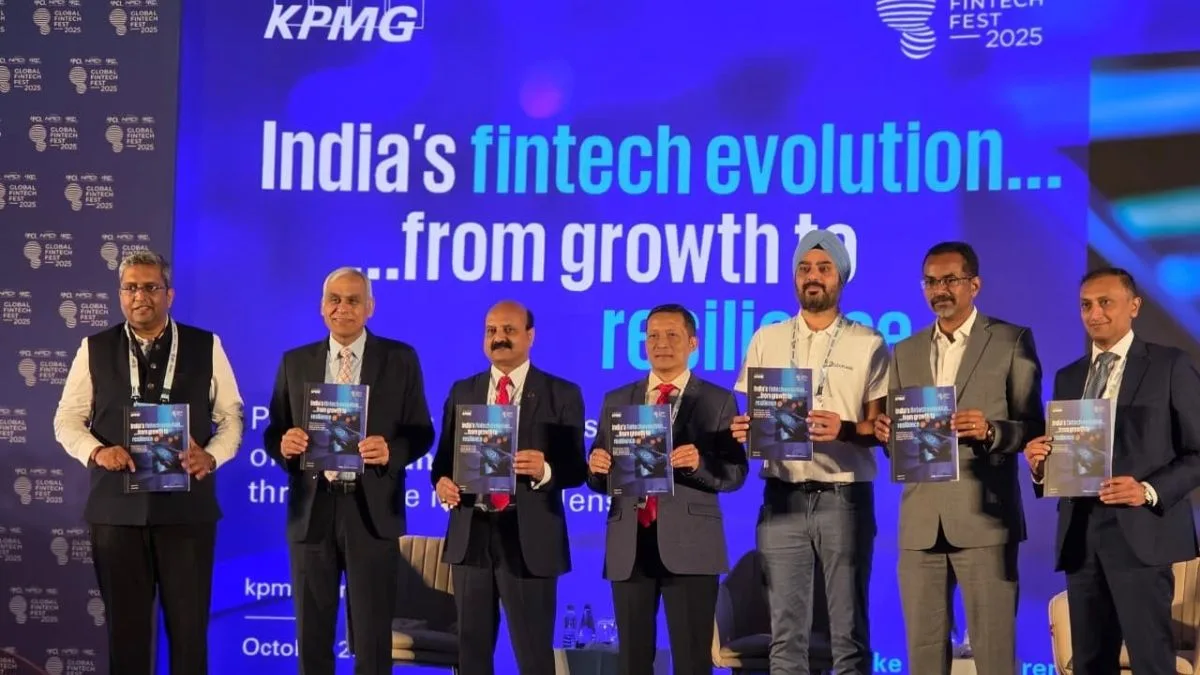
India’s fintech industry is now entering a decisive phase marked by resilience, trust and sustainable growth, said KPMG.
According to KPMG’s latest report titled “India’s Fintech Evolution From Growth to Resilience”, while India’s fintech sector has expanded at a meteoric pace over the past decade, driven by innovations in payments, lending, and financial inclusion, it is now shifting focus from rapid scale to long-term value creation and operational maturity.
Advertisement
The industry is projected to grow at a robust 31% CAGR through 2029, supported by deepening Digital Public Infrastructure (DPI), widespread UPI adoption, and expanding financial access across tier-II and III cities.
KPMG notes that private equity and venture capital flows into fintech have become increasingly selective since their 2021 peak, reflecting a global trend toward “calibrated funding.” Deal volumes dropped 54% between 2021 and 2024, but the first half of 2025 witnessed renewed investor interest in late-stage, governance-ready fintechs.
Lending and payments continue to dominate the landscape, accounting for about 60% of total funding in H1 2025. Investors now prioritise startups demonstrating strong unit economics, profitability pathways, and compliance maturity over pure user growth.
The report introduces the ‘Trust Score 1.0 Blueprint’, a proprietary framework aimed at certifying fintechs on operational reliability, governance, and regulatory hygiene. It aligns with RBI’s IT directions and India’s new Digital Personal Data Protection Act (DPDPA), seeking to streamline due diligence and foster transparent investor relationships.
“Compliance has become a competitive advantage,” said Sanjay Doshi, Partner and Head of Financial Services Advisory, KPMG in India. “Fintechs embedding KYC, explainable AI, and incident response systems into their architecture are accelerating enterprise adoption and reducing risk.”
The report also underscores India’s global competitiveness, with over 14,500 fintech firms and 31 unicorns, ranking among the top three global fintech ecosystems alongside the U.S. and U.K. With 20 billion UPI transactions per month (as of August 2025) and 1 billion internet subscribers, India’s digital economy has achieved unmatched scale.
However, KPMG warns that the next leg of growth will depend on regulatory clarity, talent development, and responsible innovation, particularly in areas like tokenisation, regtech, insurtech, and wealthtech.
Investor sentiment, the report finds, has shifted “from growth to governance.” Profitability is now seen as the “right to scale.” Venture capitalists are backing models that combine resilient technology infrastructure, strong risk management, and glocal leadership leaders who blend global insight with local market agility.
The study further predicts that the next wave of Indian fintech innovation will be anchored in AI, tokenisation, and private credit, but long-term winners will be those that balance agility with accountability.